When I’m feeling sluggish it means I need to move my body and get the endorphins flowing! Yoga and Pilates does this for me-(thanks Body Balance On Demand!), as well as a brisk walk-they are both a sure-fire mood-boosters as well!
Exercise is a very underrated anti-depressant -so be sure to get some movement each and every day for good mental health. Each step we take to move our bodies or move in line with our goals (fitness, mobility or wellbeing) is really important, no matter how small that movement is.
So do a check in-are you getting some physical movement most days during the week? And if not what can you schedule in for tomorrow?
Doing this will actually really help you move forwards with lots of other goals as well.
This week has been one of increased confusion, disappointment and anxiety as Melbourne metro goes into lockdown for the next six weeks and many families prepare to work from home and home school once more.
So whilst this is happening, it is going to be really important for us all to make sure that we are ramping up our mental health and wellbeing efforts. It’s too easy to slip into those negative emotions and get weighed down by them.
So rather than be part of that, how can we make ourselves feel extra positive and extra calm this week?
For me it is staying inside my bubble of control-there is lots that we cannot control around us and if you get caught up in mainstream media, it can fuel anxiety and cause feelings of overwhelm and powerlessness.
So focus on what you have control over-which is a great deal! You control your thoughts, your behaviour, your intentions, your emotions, so take action and dial them in the direction you choose!
So firstly thing is if you need to get an update on COVID-19, only listen to one update a day about it and then no more!
Second is doing something centring and calming for you-whether that is exercise, art, meditation, playing with your pets, watching a favourite episode of a series, putting some music on that brings you joy, anything! But make sure you have some planned ‘good-feels’ in you day today.
Then also make sure that you have some conversations with people that will make you feel good and that will not bring your mood down. Find those optimistic souls that you want to be around, ask about their day and share about yours.
And lastly make a plan for yourself this week to do something just for you each day this week-something that you enjoy, something that brings a smile, it can be simple as your favourite beverage to drink, getting outside and taking some deep breaths, staring into a fire or taking warm shower or bath, or putting on your favourite perfume or cologne.
These little moments are going to help you focus and feel great, and they accumulate bit by bit. So make a commitment to push your mood in the right direction, one day at a time!
How much does it help your life if you plan things out and how good at this task are you?
I know for myself, when I take the time to plan, life runs much more smoothly and when I find myself having the ‘can’t be’s’, the things tends to get unorganised and then this causes me to become more stressed. So for me, having a good plan and sticking to this plan is actually very calming.
Planning is a topic that often comes up for families as something they have noticed that they need to do to help their child with high anxiety cope. But simultaneously, there can be challenges found when a family might have to inform their child that the plans have to change and this is not coped with well at all. And not just for kids, I also know has experienced strong feelings of disappointment and annoyance when changes happen (which are outside your control…Covid-19, border lockdown)…that cause your plans to change!
However, finding the balance between having a good plan, and being flexible enough in our thinking to be able to develop a new plan is a sought after skill. It is certainly a skill that has had a very good workout for many of us this year. Inside the therapy room, it’s a concept we begin to introduce in later primary school years and sometimes I have called it ‘developing our ‘zig zag thinking’. This came out of making a visual of how plans can change.
So we all know that we can have intentions to make something happen (plan A) and then something unforeseen happens and we have to make a new plan (plan B), and then something else further might happen again and we have to make an even further plan (plan C). /\/\/\
Kids also sometimes say that parents have ‘lied to them’ when plans have to change-which is hard for parents to hear this and to sit with kids disappointment and confusion. The trick is finding ways of communicating with them (try visuals with language) that we now have new information that we need to consider and sometimes this new information means that we can create a new, better plan. Or that the plan will have to be enacted on another day and time.Being able to zig-zag in our approach towards our planning and being able to develop this skill can be very helpful, especially if you find that you or your loved ones like to make a plan and then want it to be stuck to, at all costs.
If you notice this tendency, perhaps try out this notion when creating a plan of building some flexibility (or some back up plans) into the plan. And remind yourself that should you need to re-write and redefine the plan, it is not being fickle or ‘airy-fairy’, but it’s showing flexibility and versatility.
Being unfiltered, being honest and being YOU can be sometimes harder than it sounds. Children are best at it, before we have skilled them too well in becoming ‘socially appropriate’ and considerate of others feelings. I know that these are important social skills, but never at the expense of losing sight of their special abilities, and their uniqueness-as is something we don’t want to ever lose. So getting that balance right can be an ongoing journey for our children, but also for ourselves and human beings. For me, I know that being less filtered and polished is something that I’m working on. Particularly because of my profession as a psychologist, there can be a big responsibility and sometimes expectations that we must behave perfectly, that we are always clinical, always thoughtful, always respectful to everyone, always giving, always patient (especially in public, and especially on social media!).
But nobody can be like that all of the time, and I’m wondering it that it may be counter-productive to helping our clients and families, if that is how we are continued to be perceived. Maybe we should also show our other sides too, and also demonstrate assertiveness, opinions, have likes and dislikes and talk about those days when being thoughtful, insightful and measured is harder to come by. So I’m here to be more authentic, to embrace my weaknesses, show my personality and remind you that I am human and can be real and flawed. Which gets me thinking is that how you’d prefer it? Is knowing that I can have great knowledge and years of experience helping others in the area of autism, parenting, child psychology and therapy but that also I have days when I’m a rubbish parent, selfish partner, inpatient and easily frustrated, helpful-or does that make what I teach less valuable?
It’s an interesting conundrum to ponder, but I think that whilst your therapy sessions don’t become about me, knowing that everyone has good days and bad, everyone has challenges, everyone has weaknesses and everyone can still be learning, (including your psychologist), can only be a positive step towards normalising what we do and who we are, and reducing the anxiety about starting a therapy or intervention journey.
So that’s a risk I’m willing to take and one that I will continue to lean into.
So I thank you for letting me be your real, raw psychologist.
Projects that allow you to take a break from you day to day demands, helps to reinvigorate and feel like you are achieving are useful projects indeed!.
I know when we first went into Stage 3 lockdown earlier this year, there was a whole lot of talk about picking up with your hobbies or finding a project to keep yourself amused with all the free time you would have. For me, I had no extra time for this, as I transitioned my practice to online in a matter of weeks and found I was busier than ever.
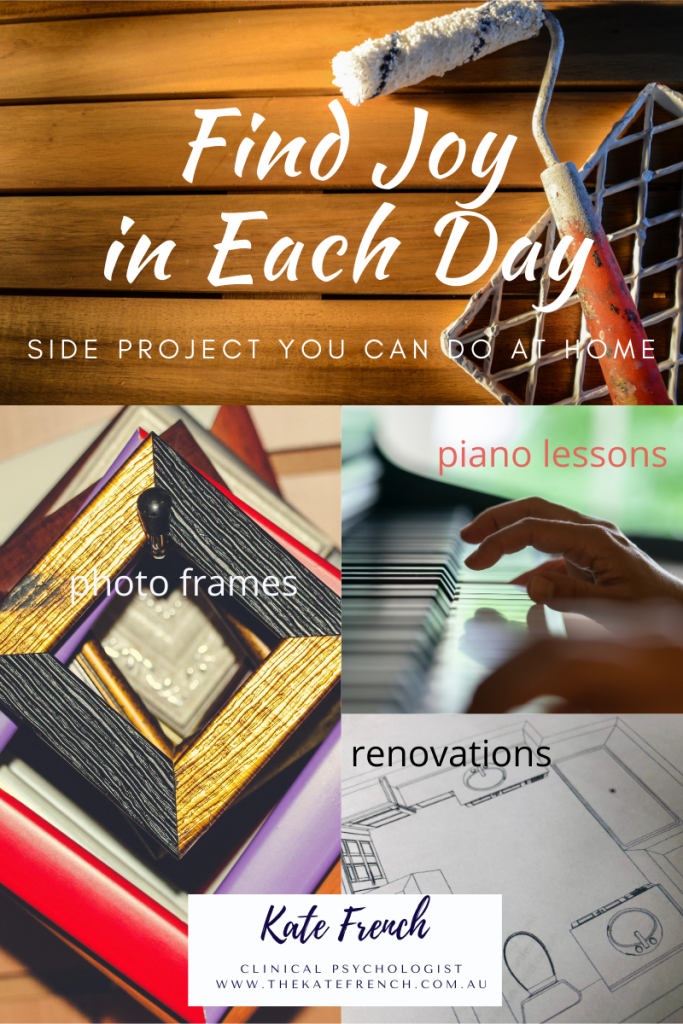
But I have a few side projects that are always there for me to put some time into. We have a bathroom and small renovation that has been mulling around in our heads for a while, and with the first teenager in the house this year, our small kids bathroom renovation is becoming a must do item as three girls struggle to find a space!
Then there are those other personal projects, like how I should continue practicing that that piano piece I started some time ago, or organising photos into picture frames, or sorting kids clothes! Whatever your project, it can be a helpful positive distraction from the stressors of work and the challenges that many people are facing now-especially Victorians in the metropolitan areas.
So use this time to focus some blocks of time on a project that brings a bit of joy and positive energy to your day!
There is something about having grace, that speaks of a dignity, thoughtfulness and respect.
It is also showing and giving thanks-as I grew up in a family where we said ‘grace’ at dinner time most nights, which is likely where my mindset of thankfulness first developed.
This is something that we certainly don’t do all the time in my family now, as in saying a prayer before our meal, but it is something that we do from time to time. For my family, ‘grace’ has evolved to always showing thanks to the person that has cooked or helped prepare dinner, which usually leads to a comment of thankfulness for the meal as well. We also often get conversations going about ‘the best thing/part of your day’, which is always a lovely reflection. These kind of rituals are simple but important way to come together at the end of the day (if it’s at dinner time), and to begin connection around the meal. Also, did you know that researchers have been progressively finding more and more evidence that regularly sharing a meal with your family is one of THE most important protective factors when it comes to positive mental and emotional wellbeing outcomes for children and teens? Something so simple to do in theory, but in reality, mealtimes can get quite disrupted by after school activities and work schedules.
I have to say, that during COVID-19 restrictions, that was one of the positives for us; that we had been having dinner together as a family almost every night for all these past months. Whereas in the past we might only make that happen three or four nights of the week. I think as things move forwards and and restrictions ease further, (and our evenings get busy again), we will need to find new times to come together for a meal-so a a family breakfast might need to be scheduled a few times a week.
So however you find your way to give thanks, think about simple ideas that feels right for you and your family.
For many, these past months have caused us to withdraw. Withdraw from socialising, our work places and at times, the very things that give joy and purpose to our life.
This is not the year that I had in mind for 2020 and despite all that it has brought to date, I am determined that this is not all it will be remembered for.
I prefer to think of the ways in which this time has actually expanded us in so many ways, with even more to be revealed. It has expanded our understanding, our empathy and our compassion across the globe. It has actually shown how connected we are, and how small things create enormous ripples and consequences. It has shown me that we always have a choice about whether to shut down and become closed off, or can we choose to open up, be brave, stay connected and expand our thinking and our visions for the future.
If these months have taught us nothing, it is that life can be unpredictable, there is much we don’t have control of, but also that there is a great deal in our own hearts and minds that we can direct. I’ve decided I want to be part of what keeps us connected, that isolation is detrimental to our wellbeing.
So choose to care and reach out rather than withdrawing, choose to envision the life that you want for you and your family and find ways that you can become more vibrant, open to change and evolution.
Choices are always there to me made; be small, stay closed or open up, fly and believe.
What do we need to do before we are ready to step up? I think there might be a bit of introspection that helps to prepare for the next step-whatever that might be. Stepping into contemplation, stepping into an imaginary future, stepping into a world without rules or objections might be what you need before you can really step up and move onto your next thing.
It might be learning, reading, talking with others, it might be meditating, journaling, getting advice and then letting that simmer and swirl around. It might be getting comfortable with the idea of change, it might be listening to the objections and dealing with these one by one. It might include revisiting your why and then exploring it further.
Either way, it is an important part of preparing for the next phase of your future and something that you need to take the time for, because stepping up usually asks us to be ourselves, but at high level. So we need to be sure we have the energy, determination and stamina to last at the higher level for the time we need to. So what do you do to help yourself step in and get focussed and how do you know when it’s time to step up?
The practice of gratitude is something that helps us through challenging times and it can help to keep us positively focused. It’s a skill that we know develops a muscle of optimism and abundance. Practices of gratitude help develop happiness on a daily basis. Getting into the habit of looking for what we have helps us to feel joy in our current lives, which then provides us with positive energy. This positive energy can then be used to buffer challenging moments in life and move towards feeling accepting of these difficulties more easily.
What I’ve noticed is that the more we practice gratitude, the easier it becomes. I find that it is easy to feel grateful for everything that I have and that this increases my compassion and empathy for others. Developing gratitude helps to combat jealousy, negativity, frustration and ‘poor-me-itis’.
It is a skill that is important for resilience and good mental health. It helps buffer agains depression and the inevitable comparisons that we tend to make against others. It helps to become less affected by the pressures to do more, buy more and compete more. If we want the skill of gratitude for ourselves and our children, it’s simple to model. And just a tip, telling children ‘to be grateful’ for what they have or reminding them of how little we may have had (at their age) is not how to develop it.
If you want to develop a stance of gratitude, it’s important to embed it into your daily routines. So it could be a question about ‘your favourite thing of the day’ at tea time, or a question about what they enjoyed about their day, just before bed. It can be just a simple question that encourages them to reflect and feel happy remembering what they already have. For older children and or teens, it’s encouraging them to develop a practice of journalling (if they like writing), or even a video journal (if they like filming themselves). There are some great journals such as Big Life Journal and happiness journals that provide wonderful prompts to get them gratitude focused. You could even do this together as well.
So if you’ve read to this point, (I’m grateful!) AND I wanted to let you know that just understanding the power of noticing the small things, can have a big impact in your life.
For me I’ve fallen in love with yoga and doing it to music-mostly the Body Balance classes. I first discovered these after my youngest was born. It was my way of gently easing my body back into physical activity after always more energetic team sports such as netball and tennis. And it turns out I love this sport even more than my others.
But these group fitness classes, which felt like home for me, much sooner than I thought they would, reminded me of my much earlier days as a dancer and have brought me a stronger, calmer and healthier mind and body. Although I have continued to practice from home, on my own, it is not the same.
In recent months during the shut down of gyms, I have missed the people that instruct these classes and the regular faces that have attend with me over the past 7 or so years. But yesterday I was fortunate enough to be invited to do a small class with a wonderful instructor, with just two other people. And we all got to practice a new release (hello sore muscles!) and talk about our love for these classes and how being in a group of people, who all love it as much as each other is something that can’t be replaced through practicing from an app.
So this love is not for another human being, it has been a journey towards loving my own body, loving the challenge that comes with learning new poses and challenging the muscles to become stronger. This love affair with yoga and moving to music, I feel will be life long.






 Kate French